
by Tuanjit Sritongchuay and Joe Chun-Chia Huang
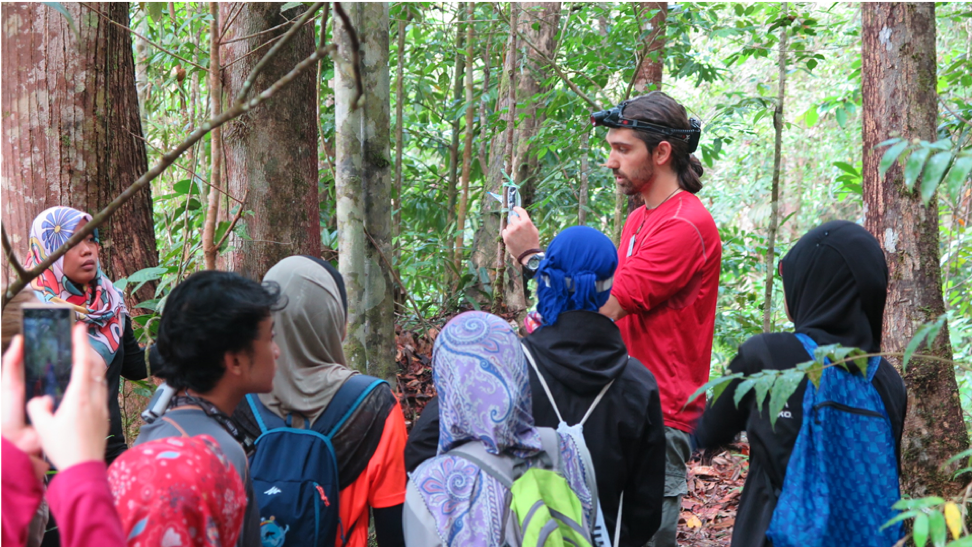
With Wallace’s memory of the largest island in Indo-Malay Archipelago, a five-day workshop on “Techniques for Bat Field Ecology” was held at Kubah National Park, Sarawak, Malaysia from June 26-30, 2018. The event was organized by the Association for Tropical Biology with logistic support by Dr. Faisal Ali Awanrali Khan and his team from the Universiti Malaysia Sarawak (UNIMAS). The workshop aimed to establish the capacity of ecological studies of bats and to form research networks among early-career bat scientists across the tropics. Twenty-eight people from 11 countries, including 14 participants, 7 facilitators and 7 volunteers from UNIMAS, joined the event. The facilitator team was composed of experienced researchers that study the behavior, ecology and biodiversity conservation of tropical bats. During the workshop, both lectures and field training covered a broad range of topics and research techniques related to bat biology from theoretical and practical perspectives.
The workshop started in the forest lodge at the Kubah National Park. After a warm welcoming by the organizers, Joe Chun-Chia Huang (Southeast Asian Bat Conservation Research Unit) and Tuanjit Sritongchuay (Xishuangbanna Tropical Botanical Garden), the national park representative introduced briefly Kubah National Park. Then Dr. Faisal Ali gave a presentation on “Bats of Sarawak in Totally Protected Areas”, but it was just the very beginning of our expedition of this wonderful forest and its biodiversity. Afterward, Joe and Adrià López Baucells (University of Lisbon) led the participants to focus on bat acoustics on the first two days. In this session, the participants explored the acoustic diversity of bats, the implications of acoustic techniques in bat research and monitoring, both passive and active acoustic surveys as well reference call collection using four different models of bat detectors, namely Wildlife Acoustics SM4 BAT FS, EM 2 Pro, Pattersson M500 UltraMic and AudioMoth. The participants also practiced call analysis using Kaleidoscope, an open acoustic analyzing tool, for sound visualization and species identification.
On the 3rd day, Adrià and Ricardo Rocha from University of Cambridge demonstrated examples and techniques of tracking individual bats in the field as well as basic analyses of tracking data. With the support of free transmitters from Dr. Jin-Nan Liu (National Chiayi University) and Biotrack, the participants experienced tracking bats in day roosts and free-ranged bats in the forest. Adrià also led the participants to map tracking point data with environmental layers by the open spatial analyzing software, QGIS. In the night, Adrià also demonstrated the participants photographing techniques of semi-free ranging bats using a motion trigger system.
The final part of the workshop mainly focused on food web ecology of bats. On June 29, Tuanjit first introduced case studies of pollination network in Thailand and various techniques in studying bats’ pollination. The participants learned pollination ecology methods and conservation practices that support bat as pollinators. They also practiced preparing reference microscope slides for pollen analysis, using camera traps to observe bat visiting flowers, and setting exclosures to measure the effects of pollination by bats. In the afternoon, Esther Ting Jin Sia from Universiti Kebangsaan Malaysia and Nur Atiqah Abd Rahman from Malaysian Cave and Karst Conservancy talked about the diverse diets of insectivorous bats. The participants learned identification skills of arthropod fragments in the feces from bats, preparing insect fragment references and analyzing fecal samples using microscopes. That evening, Ricardo demonstrated how to lift mist nets to sub-canopy level for bats flying above the height of regular ground nets. In the night, we successfully captured two uncommon pteropodid bat species, the Long-tongued nectar bat (Macroglossus minimus) and Spotted-winged fruit bat (Balionycteris maculata). On the last day, the participants continued practicing dietary analyses for both fruit bats and insectivorous bats. Ricardo then lectured on conservation evidence, a concept to evaluate the effectiveness of conservation work. He also gave an example evaluation of the workshop by interviewing the participants. Based on the feedback, all participants generally thought we were doing good! The workshop was closed in the late afternoon on June 30. This field course marks the first field course to be held in conjunction with an ATBC meeting, and following a very successful course will hopefully also be available to train further upcoming bat ecologists and enthusiasts in the future.