
Patricia Balvanera
1- What drew you to tropical biology?
I was born in Mexico City, within a very urban family, and my closest encounters with nature were the beautiful trees that surrounded the golf course where my dad played. I studied biology because I was extremely interested in the biochemical functioning of our bodies. I spent three years in a genetics lab assessing exchanges among the sister chromatids of mice as signs of undernutrition. Hours and hours in the lab met with very cruel treatments to the mice. Then I discovered a totally different world. The last year of the undergraduate program we visited several tropical sites and I was amazed. I decided to undertake a masters degree program in ethnobotany that drew me, for personal reasons, to the Los Tuxtlas Tropical Station. I so much enjoyed just staring at the tropical rain forest, listening to all the sounds, observing the sudden appearance of thousands of elephant beetles, petting once a day the wild boar named Turco. Later, I censused 10,000 trees and dug 100 soil cores over two years for my PhD thesis, this time in the tropical dry forest of Chamela, Jalisco.
2- What are exciting research developments that happened in your field during your career?
Before and during my PhD theses I was most interested in the role played by biogeographical and ecological factors in determining the spatial patterns of distributions of species, specifically beta diversity. Then, we explored the avenue of the dynamics of secondary tropical forest regeneration, both in terms of species diversity and composition, functions, and services to society. I was drawn during my postdoc and the following years to assess the spatial patters of ecosystem services and the social ecological drivers that underpin them. As time went on, through international collaboration I tackled the dynamics of social ecological systems and their resilience, and the values of nature. More recently I work with a collective of inhabitants of three territories, artists and diverse academics to co-design more sustainable local food systems. I love to be at the frontier of my own understanding to challenge myself to learn more.
3- What is your favorite memory of fieldwork?
I so much enjoyed the hundreds of hours we spent measuring trees and digging soil pits during my PhD. This is a tropical forest where life seems to vanish during the dry season. It was the day of my birthday, July 14, and rain was very late that year. After many hours of scorching sun a very intense storm started. After a couple of hours of rain pouring like crazy we were drenched and yet exhilarated. Then, suddenly, thousands of queen ants, the Palomillas de San Juan, flew from everywhere, celebrating the onset of the rainy season and the new opportunities for them to establish new nets. Very dear friends including Alfredo Pérez who taught me so much about the forest, Sandra Quijas and Efrain Aguirre who would become my students, were there to share and witness this magical moment.
4- What accomplishment by you and/or your research team are you most proud of?
I think that being a co-chair of the Assessment on the Diverse Values of Nature for the Intergovernmental Platform on Biodiversity and Ecosystem Services (IPBES) is the most relevant, challenging, interesting and fulfilling initiative in my career. I co-chaired a team of close to 100 people from 60 countries during 4 years. We built a process that was as caring and inclusive as my personal capacities, those of the teams and especially of the Technical Support Unit, and of the IPBES guidelines allowed. We assessed as many as 55,000 sources of information using 50 different search protocols. We produced a typology of values of nature, of methods to assess them, of future scenarios and capacities needed to achieve deep transformative inclusion of diverse values into decisions as well as conceptual frameworks to understand the role of power in guiding decisions, The summary for policy makers was negotiated through a relatively smooth process during 2 days with representatives of 140 countries. The importance of the diverse values of nature for sustainability was spread across the planet and used as a founding tool to build the Kunming Montreal Protocol targets. I learned so much and worked with so many close friends and we had memorable all authors meetings full of laughter, creativity and delicious food.
5- What role did the ATBC play in your career?
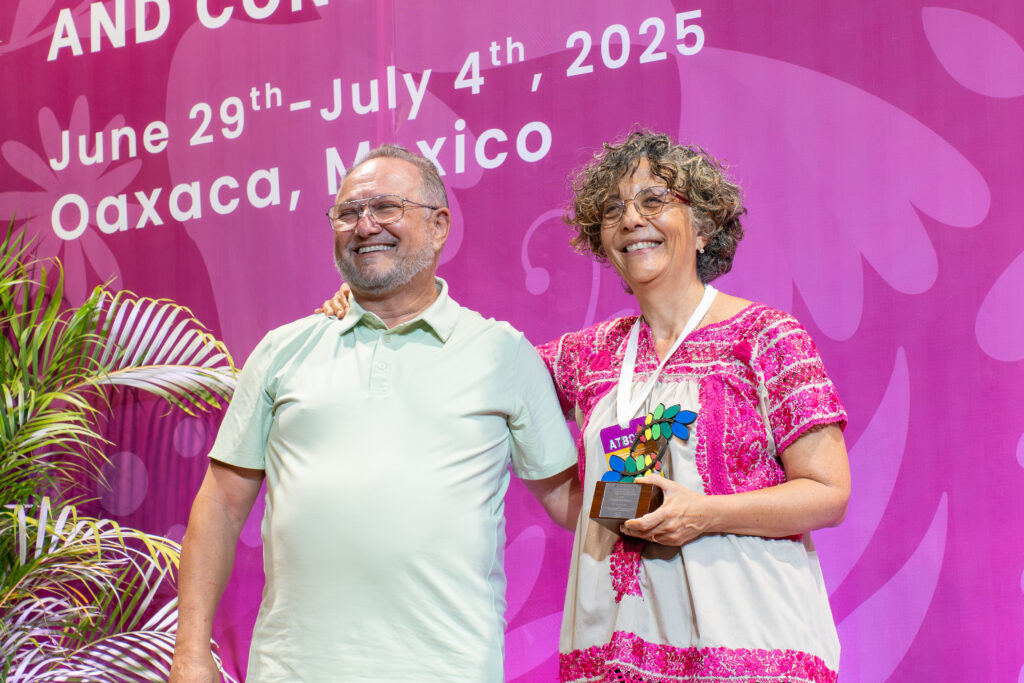
ATBC has been part of my life since 2007 when the annual meeting came to our own city, in Morelia, Michoacan, Mexico. Since, I have attended many ATBC meetings in different parts of the world. They are great opportunities to meet people we love and to know really exciting places. ATBC this year has become my academic home. The diversity of the topics and the constituency, the relaxed and festive environment, the connections with society through the mycelium and other activities of the Beyond Paradise program and the out of the box nature of many workshops and even plenaries made me feel at home and part of a thriving community.
6- What is your advice to a young scientist starting a tropical biology and conservation career?
My advice is to be bold. Place yourself at the frontier of knowledge, at the frontier of your capacities and dreams. Dream big, plan wide, and work in inclusive respectful collaborations with diverse colleagues and stakeholders to make a difference.
Geraldo Wilson Fernandes
With immense honor, humility, and deep gratitude upon receiving ATBC’s most distinguished award for 2025, I share these reflections on a journey that has been profoundly transformative. Receiving this recognition from ATBC is not something I see as a personal achievement, but rather as a collective acknowledgment. I am deeply thankful to the scientific community, to my field and lab partners, and to the local communities who have taught me so much along the way. May we continue, together, to cultivate hope within the tropics of the world!
1- What drew you to tropical biology?
In the beginning, I was deeply fascinated by the idea of becoming a marine biologist. The ocean held immense allure, but it was far from the mountainous landscapes of my homeland. Surrounded by the rugged beauty and rich biodiversity of these upland ecosystems, my curiosity gradually shifted inland.
The sheer abundance of life and the deep mystery embedded in tropical vegetation moved me profoundly. I soon became captivated by the evolutionary dynamics of ecological interactions, how they unfold and become structured over time, such as herbivory, plant defenses, and mutualisms. From early on, I was drawn to the ecological complexity of the tropics, perhaps because of the intensity and frequency of these interactions, the cultural richness so deeply interwoven with nature, and the urgent need to understand and protect these vital ecosystems.
Another key aspect was the realization that the tropics still hold many unexplored interactions, undescribed species, and poorly studied regions. There was, and still is, immense potential for discovery, and perhaps that urge to explore was something I had inherited in some way. Tropical biology offered not only scientific challenges but also the opportunity to delve into the unknown and embrace the intricate beauty of life along the equator.
A pivotal figure in this journey was my supervisor, Peter Price, whose mentorship and intellectual generosity not only deepened my understanding of ecological theory but also allowed me to keep dreaming and growing. His influence helped turn initial curiosity into a lifelong commitment.
I believe the call to tropical biology was not just scientific—it was also deeply personal. It was a calling of the heart.
2- What are exciting research developments that happened in your field during your career?
Throughout my career, I have witnessed extraordinary advancements, from the revolutionary use of remote sensing technologies to map biodiversity, to the rise of metagenomics revealing cryptic species and their interactions within little-known ecological layers. Chemical ecology has reshaped our understanding of species interactions and biogeography, while regenerative ecology and nature-based solutions have opened new paths for conservation and restoration.
I’ve had the privilege of experiencing this momentum firsthand, where the pace of discovery is exhilarating—only occasionally slowed by the chronic lack of investment in tropical regions. What moves me most, however, is the growing recognition of interdisciplinary approaches, where scientific knowledge walks hand in hand with the traditional wisdom of local communities.
Indeed, I feel I have been living through a thrilling era of discovery.
3- What is your favorite memory of fieldwork?
Among many unforgettable memories, one that I hold dear is the first time I was introduced to an insect gall. At the time, I had no idea what it was. I was told that this small, green structure, adorned with trichomes and resin droplets that trapped minute parasitoids, was the result of a poorly understood interaction. It was both bizarre and fascinating: a complex parasitic relationship between an insect and its host plant that very few professors knew about, and that was almost entirely unknown to society.
The second defining moment came when I first encountered the vegetation of the campo rupestre. It seemed almost impossible that such a community could exist—its architecture, diversity, and the exuberant colors of its flowers and foliage were utterly mesmerizing. In both cases, I was overwhelmed by the richness and complexity of these systems, and by the realization of how much knowledge still needed to be uncovered and shared with the world.
It was then that I decided to leave behind my early dream of becoming a marine biologist and dedicate myself to exploring the intricate interactions between plants and animals.
4- What accomplishment by you and/or your research team are you most proud of?
More than publications, we take pride in having actively contributed to unveiling the intricate and diverse interactions between animals and plants that shape the natural world. We’ve strived to apply this knowledge in conservation projects that have made a real difference for both tropical habitats and the communities that depend on them.
Although progress in these fields can take decades, we’ve been able to demonstrate that such fundamental knowledge is essential for restoring ecosystems damaged by human activity. Witnessing degraded areas come back to life, working hand in hand with local leaders—and even with sectors of society traditionally associated with environmental exploitation—has been challenging, but it has also proven possible. Each step forward has been a cause for celebration.
Equally important has been mentoring and training the next generation of engaged young tropical scientists. That, perhaps, is what makes us most proud.
5- What role did the ATBC play in your career?
ATBC has been a true foundation in my journey. It was where I found mentors, collaborators, and friendships that inspired and supported me throughout my career. The ATBC community welcomed me, challenged me, and guided me, opening doors to international dialogue and fostering collaborations that transformed the way I do science.
The ATBC meetings represent, in my view, the most important space for tropical biologists to openly and comfortably discuss the unique challenges and questions that arise from working in the tropics. In this truly singular setting, we meet people from all corners of the globe, friendly, generous, and eager to share knowledge and build partnerships to explore the planet’s most complex ecosystems.
For me, it is the best space to share discoveries, learn from others, and forge the collaborations needed to accelerate our understanding of the tropical world. I am deeply grateful for everything I have experienced and learned in this community, where we are all united by our focus on the tropics.
6- What is your advice to a young scientist starting a tropical biology and conservation career?
Pursue your path with passion and humility. Travel, observe, and listen attentively to the grasslands, savannas, and forests, and above all, to the people who live within them. Strive for scientific excellence, but never forget the importance of empathy and respect.
If you are fortunate to live in these tropical paradises, embrace this responsibility with even greater intensity. You are uniquely positioned to generate the knowledge that can drive the transformative changes we urgently need to protect tropical biodiversity.
In this effort, collaboration with colleagues from temperate regions, who also cherish and understand tropical biology, is essential and must be continually strengthened. Tropical science demands courage, collaboration, and a deep commitment to social and environmental justice.
Believe that every small step matters, and that your voice counts. In this moment of widespread environmental degradation, the tropics stand out as among the most fragile, complex, and vital regions for the planet’s balance. That is why we need a new generation of deeply engaged scientists from all corners of the world, ready to rise to this challenge.