The Association for Tropical Biology and Conservation recognizes the exceptional research of our students and early career scientists with awards for outstanding presentations at the ATBC’s annual meeting. The Luis F. Bacardi Award for Advances in Tropical Conservation is awarded to the individual receiving their Ph.D. no more than 5 years before the meeting date who gives the best oral presentation. This award was established in 2005 with an endowment from the Lubee Bat Conservancy, an international non-profit organization based in Gainesville, Florida, that was founded in 1989 by the late Luis F. Bacardi and is dedicated to protecting biological diversity through the conservation of fruit- and nectar-feeding bats. The Alwyn Gentry Presentation Awards are in recognition of the outstanding oral and poster presentations by students at the ATBC’s annual meeting. Alwyn H. Gentry’s legacy to tropical biology was not limited to the study of the diversity and conservation of tropical plants—he was a caring and supportive mentor to students from all over the Americas. These awards are therefore in remembrance and recognition of the contributions of this singular scientist, colleague, mentor, and friend.
The New Phytologist Foundation, an independent, not-for-profit organization dedicated to the promotion of plant science, is proud to support student researchers by awarding the New Phytologist Best Presentation Prizes in Plant Biology at the ATBC Annual Meeting.
On behalf of the ATBC we would like to thank the early-career scientists that presented their work at the 2025 ATBC Meeting in Oaxaca, extend our gratitude to the many meeting delegates who served as judges, and congratulate the following recipients for their outstanding presentations.
Imma Oliveras and Meghna Krishnadas
Gentry and Bacardi Award Co-Chairs
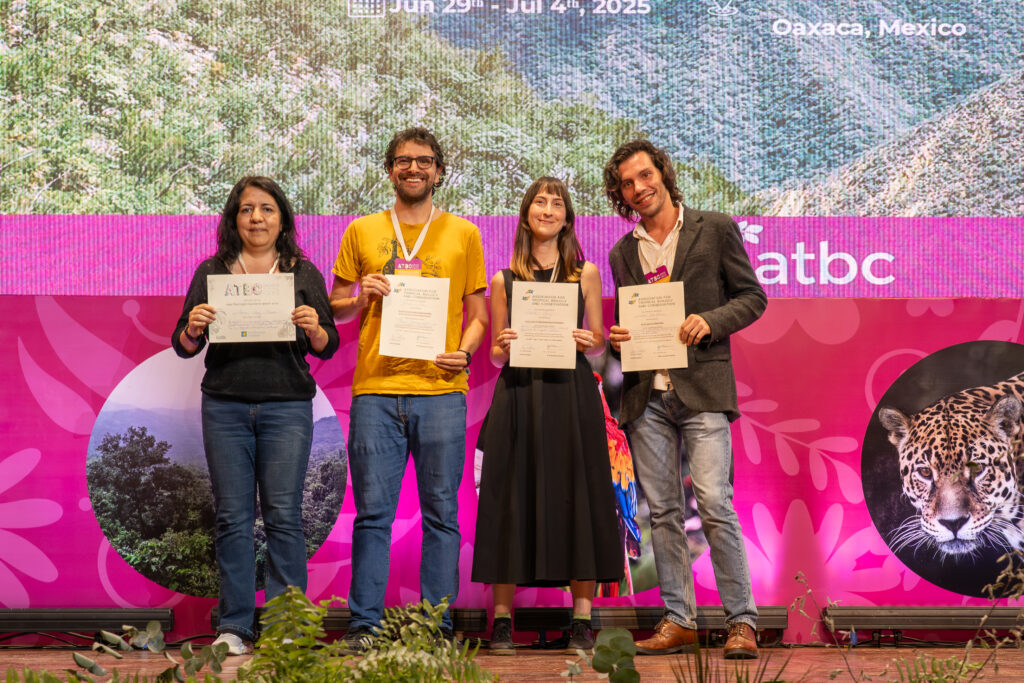
2025 Luis F. Bacardi Award for Advances in Tropical Conservation
Julián León
Universidad del Rosario, Colombia
No experience necessary – for wildlife to fear the human “super predator”
Julián León, Universidad del Rosario
Meg Crofoot, Max Planck Institute of Animal Behavior
Michael J Clinchy, Western University
Liana Zanette, Western University
Humans worldwide kill prey at much higher rates than other predators, making humans a uniquely lethal global “super predator” – as has likely long been the case. Fear of humans can correspondingly be expected to far exceed and persist far longer than the fear of other predators. Barro Colorado Island (BCI; 15.6 km2) was created when the Chagres River was dammed to create Lake Gatun as part of the Panama Canal in 1914 and has been a nature monument since 1923. Jaguars have been sighted infrequently on BCI’s 100-year history, with the most recent confirmed sighting in 2009, and the last reported incident of poaching was in 1987. Researchers and staff are resident year-round and hundreds of tourists visit annually. If individual experience governs fear of predators, the wildlife on BCI would be expected to show little fear of jaguars and none of humans. We experimentally tested the fear of jaguars and humans among the most common mammals on BCI (N = 7 species), using automated camera-speakers (Automated Behavioral Response systems; ABRs) broadcasting playbacks of jaguars, humans, or non-predator controls (birds or frogs). Preliminary results demonstrate that, considering the community as a whole, mammals on BCI have retained their fear of both jaguars and humans, running more or abandoning the site significantly more often upon hearing either than upon hearing controls; and they moreover fear humans more than jaguars, as they run more from humans than jaguars and abandon significantly more often to humans than jaguars. The evidence that fear of humans pervades the prey community of the island – even when the last incident of poaching occurred long before any of the present animals were born – strongly suggests that evolutionary history rather than individual past experiences shapes wildlife’s fear of the human “super predator”.
2025 Alwyn Gentry Award for Best Oral Presentation
Luisa Genes
Stanford University
Evaluating the restoration of plant-animal interactions through trophic rewilding
Luisa Genes, Stanford University
Fernando A.S. Fernandez, Universidade Federal do Rio de Janeiro
Ângelo Antônio Corrêa, Escola Superior de Agricultura “Luiz de Queiroz”, Universidade de São Paulo (USP)
Matheus ADL Agles, Universidade Federal do Rio de Janeiro
Pedro M. Galetti, Universidade Federal de São Carlos
Maron Galliez, Instituto Federal de Educação, Ciência e Tecnologia do Rio de Janeiro
Carla C Gestich, UFSCar
Marcelo L. Rheingantz, Universidade Federal do Rio de Janeiro
Lais Lautenschlager Rodrigues, University of Miami
Joana Macedo, Refauna
Rafaela Pacheco, Universidade Federal Rural do Rio de Janeiro
Bruno H. Saranholi, Universidade Federal de São Carlos – UFSCar
Alexandra S. Pires, Universidade Federal Rural do Rio de Janeiro
Rodolfo Dirzo, Stanford University
Trophic rewilding consists of species reintroductions to restore trophic interactions and associated ecological processes. Monitoring species interactions in trophic rewilding is critical to assessing whether animals fulfill their ecological roles, yet it remains rare due to its field-intensive and time-consuming nature. Here, we used DNA-metabarcoding to quantify plant-animal interaction restoration following the reintroduction of the lowland tapir (Tapirus terrestris) to a Brazilian Atlantic Forest site where they had been extinct for over a century. Tapirs are regarded as “forest gardeners” because they move large distances, disperse seeds from plants they eat, browse on abundant understory plants, and trample on seedlings of several dominating plants. We collected 75 fecal samples of reintroduced tapirs over two years, and 30 fecal samples from an extant tapir population at a different site. We extracted plant DNA and used three primers (P6loop, ITS-Asteraceae, and rbcL) to amplify plant DNA from feces. PCR products were sequenced on an Illumina HiSeq platform. Sequence data were then curated and compared to local sequence databases to identify plant species in each sample and compare the dietary interactions of extant and reintroduced tapir populations. Reintroduced tapirs interacted with at least 97 plant species, and their diet was independent of fruit composition, suggesting a high prevalence of herbivory. Still reintroduced tapirs diet included fewer species and was compositionally different than the extant population. These dietary differences could suggest that reintroduced tapirs may play distinct ecological roles due to captive naivety. Monitoring species interactions in trophic rewilding can shed light on the ecological role of a keystone herbivore and inform new trophic rewilding initiatives.
2025 Alwyn Gentry Award for Best Poster Presentation
Iñaki Quintana
Centro Interdisciplinario de Investigación para el Desarrollo Integral Regional, Unidad Oaxaca
Passive acoustic monitoring of marine mammal communities and anthropogenic noise impact in Oaxaca’s coastal waters
Iñaki Quintana, CIIDIR, Unidad Oaxaca
Gustavo Hinojosa, Instituto Politecnico Nacional
Jaime Matus-Parada, Universidad Autonoma Metropolitana
J. Roberto Sosa-López, Instituto Politecnico Nacional
Coastal ecosystems are among the most diverse yet vulnerable habitats globally, with marine mammals serving as key indicators of ecosystem health. On the central coast of Oaxaca, Mexico, increasing human activities, such as maritime traffic and tourism, threaten the acoustic environment, which is essential for marine mammal communication and behavior. This study aimed to evaluate the ecological structure of marine mammal communities and associated noise levels using passive acoustic monitoring (PAM). Based on ecological theory and recent advances in bioacoustics, we hypothesized that sites with elevated natural and anthropogenic noise would exhibit altered acoustic indices and reduced biological acoustic activity compared to quieter areas. To test this, autonomous SM3M (Wildlife Acoustics) recorders were deployed at three coastal locations. The recording effort spanned 29 days from April to May 2018 across all sites, with recordings conducted one day in February at two sites and 29 days in June at one site. Recordings were made at a depth of 20 meters with a 48 kHz sampling rate and 16-bit resolution. The hydrophones had a sensitivity of −164.5 dB re 1 µPa and a 12 dB gain. Acoustic data was processed using BirdNET Analyzer, Raven Pro, and PAMGuard. We calculated key indices, including the Normalized Difference Soundscape Index (NDSI), Acoustic Complexity Index (ACI), Acoustic Diversity Index (ADI), Acoustic Evenness Index (AEI), and frequency-based indices (LFC, MFC, HFC). Broadband Sound Pressure Levels (SPL) and NOAA’s marine mammal weighting functions were used. Preliminary results show that PAM effectively captures spatial and temporal variations in marine mammal activity and ambient noise. Recorded species included spinner dolphin (Stenella longirostris), pantropical spotted dolphin (Stenella attenuata), bottlenose dolphin (Tursiops truncatus), and migratory baleen whales like the humpback whale (Megaptera novaeangliae). These results highlight PAM’s value for long-term monitoring and emphasize the need to address acoustic impacts in marine conservation.
2025 New Phytologist Prize in Plant Biology Best Oral Presentation
Ellen Quinlan
Wake Forest University
Patterns of diversification, gene flow, and functional diversity across an Andes elevation gradient
Ellen J Quinlan, Wake Forest University
James B Pease, The Ohio State University
Jhonatan Sallo-Bravo, Wake Forest University
Alfredo Fuentes, Herbario Nacional de Bolivia, Missouri Botanical Garden
Mia Springer, Wake Forest University
William Farfan-Rios, Washington University in Saint Louis
Miles Silman, Wake Forest University
The high biodiversity of tropical Andean forests is characterized by many closely related species which turnover rapidly across steep elevation and environmental gradients. Yet, the eco-evolutionary relationships among these congeneric species remain poorly understood – particularly how they diversify, sort into their elevational niches, and maintain species boundaries. In this study, we investigate these processes in the genus Prunus (cherries) by 1) reconstructing the phylogenetic relationships among sympatric species, 2) assessing gene flow among species across an elevation gradient and through time, and 3) testing the correspondence between functional and phylogenetic diversity. To achieve this, extensive population-level sampling was conducted for seven species which co-occur along an elevational gradient in Manu National Park, Peru. Additional samples were collected from species which co-occur in Madidi National Park, Bolivia, for a total of 10 Andean species along with three outgroups. DNA was extracted and sequenced using ddRAD-seq, with reads processed in iPYRAD. Phylogenetic relationships were inferred via maximum likelihood and Bayesian analyses, revealing evidence of upslope adaptive diversification concurrent with Andean orogeny during the Miocene. Gene flow analyses uncovered both historical introgression and recent admixture, findings that were widespread among species and across the elevation gradient. Further, we employed Fourier-transformed infrared spectroscopy (FT-IR) to analyze the spectral signatures of each sampled individual, to assess whether functional diversity corresponded to the phylogenomic diversity. Despite phylogenomic discordance, leaf functional diversity largely supports the ecological and morphological differentiation among species. This suggests that during adaptive radiations, observable ecological, morphological, and functional differences may emerge long before complete phylogenomic isolation, even amid ongoing gene flow. Overall, our results advance understanding of the origin, maintenance, and coexistence of closely related species across elevation gradients within the genus Prunus and the Andean tree flora more broadly, carrying important implications for predicting community responses to climate change.
2025 New Phytologist Prize in Plant Biology Best Poster Presentation
Liliana López-Olmedo
Universidad Nacional Autónoma de México
Decoupled environmental filtering between plant taxonomic and phylogenetic diversities in a tropical heterogeneous landscape
Liliana I. López-Olmedo, Universidad Nacional Autónoma de México
Jorge A. Meave, Universidad Nacional Autónoma de México
Claudia Moreno, Universidad Autónoma del Estado de Hidalgo
Jorge Cortés-Flores, Universidad Nacional Autónoma de México
Guillermo Ibarra-Manríquez, Universidad Nacional Autónoma de México
Eduardo A. Pérez-García, Universidad Nacional Autónoma de México, Facultad de Ciencias
Local floras encompass fewer species and lineages than their corresponding regional flora. Such reduction partly results from the environmental filtering acting locally, so that only some species from the regional pool can successfully colonize a particular habitat, based on their ability to survive and thrive under certain conditions. In this study, we asked if the magnitude of the environmental filtering is similar for the taxonomic and phylogenetic dimensions of local floras in heterogeneous landscapes. Considering that closely related species display similar environmental affinities (due to niche conservatism), we hypothesized that in heterogeneous landscapes (where filtering power is highly variable across landscape units) more restrictive filters discriminate lineages more efficiently than species. We predicted decoupling between the phylogenetic and taxonomic diversities in different landscape units. We used floristic information gathered during three decades in a tropical dry landscape (S Mexico) that comprises seven vegetation types differing in community structure and physiognomy, each one hosting a different fraction of the 993 species representing the regional pool. We constructed the phylogenetic tree of the regional flora (based on a mega-phylogeny for seed plants and pteridophytes) and calculated two taxonomic relatedness indices and the standardized effect size of phylogenetic diversity. The fraction of species from the regional pool that were filtered out in local floras ranged from 33 to 91%; clade ages in the regional pool ranged from 400 to < 0.5 My. Five floras had an under-dispersed phylogenetic structure, whereas only species from the semi-evergreen tropical forest were less related to each other than randomly expected. In line with our prediction, five vegetation types (e.g. savanna and xerophytic scrub) displayed lower phylogenetic diversity (ses.PD values: -5.3 to -2.8) than expected according to their taxonomic richness (null model), suggesting a more restrictive environmental filtering in them than in communities where the phylogenetic structure was over-dispersed.