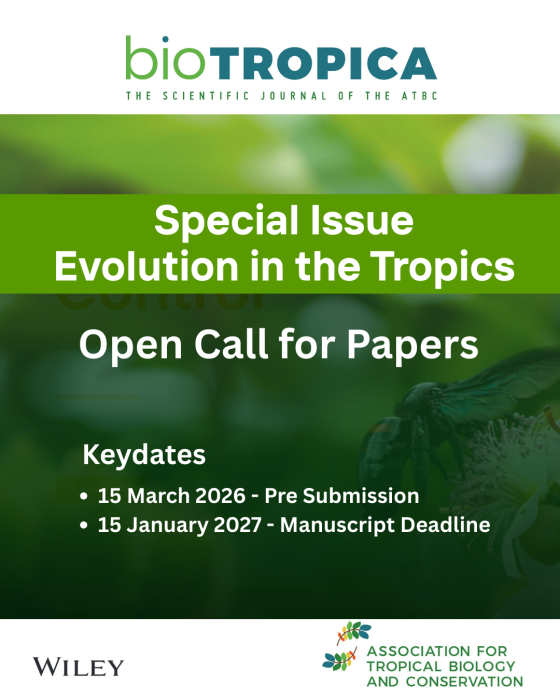
We are excited to announce a call for papers for a Special Issue on Evolution in the Tropics. This initiative recognizes the fundamental importance of tropical organisms and ecosystems to evolutionary biology and the urgent need to study and understand evolutionary processes in Earth’s most biodiverse regions.
The Tropics at the Heart of Evolutionary Theory
The tropics have been central to the development of evolutionary thought since its inception. From Darwin’s observations in the American tropics to Wallace’s insights in the Malay Archipelago, tropical biodiversity has inspired foundational questions about the mechanisms driving diversification, adaptation, and the origins of life’s extraordinary diversity. Today, as tropical ecosystems face unprecedented environmental change, understanding evolutionary processes in these systems is not only scientifically interesting but essential for predicting and managing responses to global challenges.
Tropical regions harbor the majority of Earth’s biodiversity, exhibit the highest rates of diversification across numerous lineages, and span ecosystems from rainforests and coral reefs to savannas and montane forests. These systems continue to provide unparalleled opportunities to address fundamental questions in evolution while offering critical insights into how life on Earth has responded to environmental changes.
Scope and Topics
We invite submissions that advance our understanding of evolution in tropical systems across the full breadth of evolutionary biology. We welcome studies from all tropical regions and ecosystems, and particularly encourage submissions that:
Areas of particular interest include (but are not limited to):
Types of Contributions
We welcome original research articles, synthetic reviews, perspectives, and methodological papers. Manuscripts may address empirical, theoretical, or applied questions. We particularly encourage:
Submission Process
Proposals (optional but encouraged): Authors may submit a 300-word proposal, including a summary, article type, tentative title, and author information, to editor@biotropica.org by 15 March 2026. Proposals will receive feedback within three weeks. Note: Proposals are optional; authors may submit full manuscripts directly.
Full manuscript deadline: 15 Jan 2027
Submission portal: Manuscripts should be submitted through Biotropica’s online system, selecting “Special Issue: Evolution in the Tropics” as the article type.
All submissions will undergo rigorous peer review following Biotropica’s standard procedures. Accepted papers will be published online as they are completed and then compiled into the Special Issue.
Note: Papers published in special issues typically receive greater visibility, downloads, and citations compared to regular issues, enhancing the impact and reach of your research.
For inquiries, please contact fzapata@ucla.edu