Each year, the Association for Tropical Biology and Conservation celebrates outstanding research presented by students and early-career scientists at the ATBC Annual Meeting. These awards recognize not only excellent presentations, but also the creativity, dedication, and contributions of the next generation of tropical biologists and conservation scientists.
At the 2026 Annual Meeting in Xishuangbanna, China, five researchers were recognized for their outstanding oral and poster presentations through the Luis F. Bacardi Award for Advances in Tropical Conservation, the Alwyn Gentry Presentation Awards, and the New Phytologist Best Presentation Prizes in Plant Biology. Meet this year’s award recipients and learn more about the research they presented below.
The Luis F. Bacardi Award for Advances in Tropical Conservation recognizes the best presentation by an early-career conservation scientist who received their Ph.D. no more than five years before the meeting. Established in 2005 with an endowment from the Lubee Bat Conservancy, the award honors the legacy of Luis F. Bacardi and his commitment to biodiversity conservation.
The Alwyn Gentry Presentation Awards recognize outstanding oral and poster presentations by students at the ATBC Annual Meeting. The awards honor the legacy of Alwyn H. Gentry, whose contributions to tropical biology extended beyond his influential research on tropical plant diversity and conservation to his dedication as a caring and supportive mentor to students throughout the Americas.
The New Phytologist Foundation, an independent, not-for-profit organization dedicated to promoting plant science, supports student researchers through the New Phytologist Best Presentation Prizes in Plant Biology, recognizing outstanding oral and poster presentations in plant biology at the ATBC Annual Meeting.
We thank all the students and early-career scientists who shared their research and participated in this year’s presentation awards. We are also deeply grateful to the ATBC members and meeting delegates who generously contributed their time and expertise as judges. Congratulations to all of our 2026 award recipients!
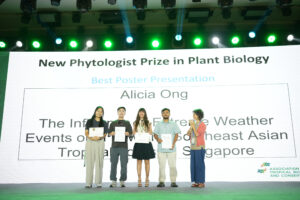
ATBC 2026 Best Presentation Award recipients receiving their awards from Natalia Norden, ATBC President.
2026 Luis F. Bacardi Award for Advances in Tropical Conservation
Guangxi University, China
Junjie Liu, Guangxi University
Aiwu Jiang, Guangxi University
Protected areas (PAs) serve as a primary conservation strategy to mitigate wildlife defaunation and trophic downgrading associated with human activities. However, it remains poorly understood how well they preserve terrestrial biodiversity and maintain food webs, and what factors promote their effectiveness. Here, we synthesized a nationwide camera trap dataset to evaluate the effectiveness of China’s PAs in conserving biodiversity and maintaining network complexity. We reconstructed the historical community for each site by combining species’ historical occurrence and extant range. Species that historically occurred at a site but were not detected in recent surveys were considered functionally extinct there. We calculated linkage density to evaluate the complexity of the food webs. We then quantified the impacts of human-driven species loss on these food webs. Our findings indicate that larger PAs are more effective in reducing species loss, but human populations outside PAs jeopardize biodiversity protection inside PAs. Despite an extensive PA system across China, 76% of medium- and large-sized species have not been found in over half of their historically inhabited PAs since the mid-1900s. Current communities corresponded with a substantial 70% decrease in network complexity compared to historical communities, and the average linkage density decreased by approximately 22.9% compared to the random scenario. This has resulted in a network of sites with unbalanced food webs, exceeding what would be expected from random species loss. Our findings indicate that future optimization strategies for the PA system should increase the size of individual PAs, and construct trans-regional ecological corridors to enhance connectivity and mitigate external anthropogenic disturbances. Integrating the reintroduction and rewilding of apex predators into key conservation strategies is essential for restoring food web integrity. These initiatives have global significance for scaling up conservation efforts and achieving the “30 by 30” targets for PAs.
2026 Alwyn Gentry Award for Best Oral Presentation
Adelaide University, Australia
Aamer Sohel Khan, University of Adelaide
Ramesh Krishnamurthy, Wildlife Institute of India
Todd J McWhorter, University of Adelaide
The endangered red panda (Ailurus fulgens) remains poorly studied in the Indian Eastern Himalayas, limiting evidence-based conservation planning. We conducted a preliminary, single-season, sign-based occupancy survey across 36 hexagonal grids (1 km² each) in Singalila and Neora Valley National Parks to establish baseline occurrence and to examine factors influencing the detection of red panda faecal pellets. We fitted occupancy models using the unmarked package in R.
Naïve occupancy was 0.56 in Singalila and 0.40 in Neora Valley (mean = 0.48). We explicitly tested whether detection probability was driven by overall walking effort or by targeted tree-search effort. Model selection strongly supported detection as a function of tree-search effort (β = 1.79 ± 0.49 SE, p < 0.001), whereas walking distance alone had a negligible effect on detection.
After accounting for imperfect detection, the null occupancy model received the highest support. Habitat covariates—bamboo density, elevation, tourism intensity, and park identity—showed weak and equivalent support (ΔAIC ≈ 2), suggesting either relatively homogeneous occupancy across the surveyed landscape or limited statistical power to detect habitat relationships given the current sample size.
Overall, these preliminary results demonstrate that detection processes, particularly targeted tree-based searches, strongly influence inference in sign-based surveys of arboreal species. This study provides an initial baseline for red panda monitoring in eastern Himalayan protected areas and highlights the need for increased replication and multi-season sampling to strengthen inference about habitat occurrence for conservation planning.
2026 Alwyn Gentry Award for Best Poster Presentation
Bharati Vidyapeeth Deemed University
Aadithi Gopalakrishnan, Bharati Vidyapeeth Deemed University
Tak Fung, National University of Singapore
Accurate population assessments are critical for the recovery of species threatened by the illegal wildlife trade. The Straw-headed Bulbul (Pycnonotus zeylanicus) is a Critically Endangered Southeast Asian songbird driven to near-extinction by poaching for the illegal songbird trade. The absence of standardised population estimates across much of its range hinders effective conservation planning.This study aims to use passive acoustic monitoring to estimate the population size of one of the last strongholds of the species in Pulau Ubin, Singapore, a 10 km2 island dominated by back mangrove and young secondary forest, where poaching is absent. We deployed autonomous recording units across Ubin, which act as silent observers capturing vocalizations of species upto a certain detection range. We then developed statistical models to convert the number of songs into the number of adult birds. We used a dynamic stage-structured model to estimate the number of juvenile birds for a complete population assessment. Under a binary habitat classification of suitable or unsuitable, we found a median estimate of 942 Straw-headed Bulbuls on Pulau Ubin, with a 95% Bayesian credible interval of [585, 1428]. These densities are high for a large songbird and indicate that in the absence of poaching the Straw-headed Bulbul can thrive even in disturbed secondary forests. Our study demonstrates that passive acoustic monitoring, widely applied in temperate systems, can also produce reliable population estimates in structurally complex tropical forests, providing a scalable and non-invasive framework for monitoring threatened vocal species.
2026 New Phytologist Prize in Plant Biology Best Oral Presentation
University of Montpellier, France
Artemis Anest, University of Montpellier
Introduction & Background. Can plants adapt to ongoing and coming global changes? Over evolutionary time, plant lineages have experienced many other ecological threats, e.g., the diversification of browsing mammals (opening ecosystems and preying on plants), the rise in temperatures and glaciations (affecting their physiological functioning), or the increase in fire regimes (causing the destruction of all aboveground biomass). Faced with these incoming threats, plant lineages have adopted two ways of responding: : either shifting geographically or ecologically, or evolving traits allowing persistence under these new environmental pressures.
Justification. These two evolutionary processes, shifting and evolving, have shaped the history of plant lineages, as well as global vegetation. Understanding when and how plant clades have followed one or the other of these evolutionary paths can inform us about the potential for current plant biodiversity to do so under ongoing global change. Integrating phylogenetic and ecological history is therefore essential to assess biome sensitivity worldwide and identify which plant lineages are most vulnerable to global changes.
Objective. I will show how reconstructing the evolutionary and ecological history of plant lineages provides a predictive framework to understand their capacity to shift, adapt, or decline under ecological change, and how this knowledge can inform conservation of plant and associated biodiversity.
Methods Using case studies in two major tropical families, Euphorbiaceae and Combretaceae, I will illustrate how this knowledge can improve our capacity to anticipate plant diversity’s future by:
Results 1) describing mechanisms facilitating plant lineages to shift ecologically, and how this has affected their current distribution; 2) identifying the evolutionary steps that have enabled plants to survive and diversify in environments newly exposed to novel ecological threats; and 3) understanding how these two processes can synergistically interact to transform vegetation.
Anest et al., 2021, New Phytologist.
Anest et al., 2024, Nature Plants.
2026 New Phytologist Prize in Plant Biology Best Poster Presentation
National University of Singapore, Singapore
Alicia Xiang Ting Ong, National University of Singapore
Jun Ying Lim, National University of Singapore
Siew Chin Chua, National University of Singapore
Climate change is increasing tree mortality across tropical forests globally through its effect on extreme weather events, but has been poorly explored in Southeast Asia. Using a long-term forest census dataset (26 years) and historical weather data from a lowland equatorial tropical forest in Singapore, we analysed the effect of extreme weather events such as rainfall and temperature anomalies and wind bursts on growth and mortality patterns on 27 native tree species. In addition, we examine the degree to which leaf economic and plant physiological traits relevant to plant-water relations may explain interspecific variation in demographic outcomes. Species-specific survival and growth rates among census intervals were estimated using Bayesian models and the relative contribution of extreme weather and intrinsic species traits were evaluated using linear models. We find that extreme weather events and certain functional traits were correlated with survival probabilities across intervals, but there was a consistent downward long-term trend in survival probabilities across the species examined. This suggests either a strong role for long-term climatic changes or other landscape-level factors in driving forest trajectories in Southeast Asian forests.